Flattening the curve of competitive gaming.
Competitive games aren't too hard. They're badly introduced. The rules are in the manual, but the things you actually need — what the words mean, what you're supposed to be looking at, what to practice on a Tuesday night — get passed around by word of mouth and never written down. This is where I write them down.
The same destination, a very different first month
Most people quit somewhere in the flat part.
The wall isn't difficulty. It's vocabulary.
Every competitive game has a layer of shared knowledge that experienced players forget they ever learned. Until you have it, you're not losing to better play — you're losing to not knowing what's happening.
You can't practice what you can't name
"Get better at neutral" is useless advice until someone tells you neutral is the part of the match where nobody has the advantage yet, and that it's mostly about spacing. Naming a thing turns it into something you can work on.
The tutorial teaches the rules, not the game
In-game tutorials teach you which button does which move. They rarely teach you what to do when you're getting pressured in the corner, or why the thing you keep doing keeps losing. That gap is where most people quit.
Losing is the curriculum
You will lose a lot early and that is not a signal to stop. It's the only way to collect the specific problems worth practicing. Every guide here is built to shorten the time between losing and understanding why.
Two kinds of game. Seven on-ramps.
Two shelves, because a card game and a fighting game ask completely different things of a beginner — one wants you to read a rule correctly, the other wants you to build a habit. Each guide assumes you've never played its genre. Read in order or jump to the part you're stuck on. All free, all in the browser, all built to work on the phone in your hand at the table or on the couch.
Card games
4 guidesEverything happens on a table, in turn order, with information you can see. The hard part isn’t reflexes — it’s knowing what a card is allowed to do and when the other player gets to respond.
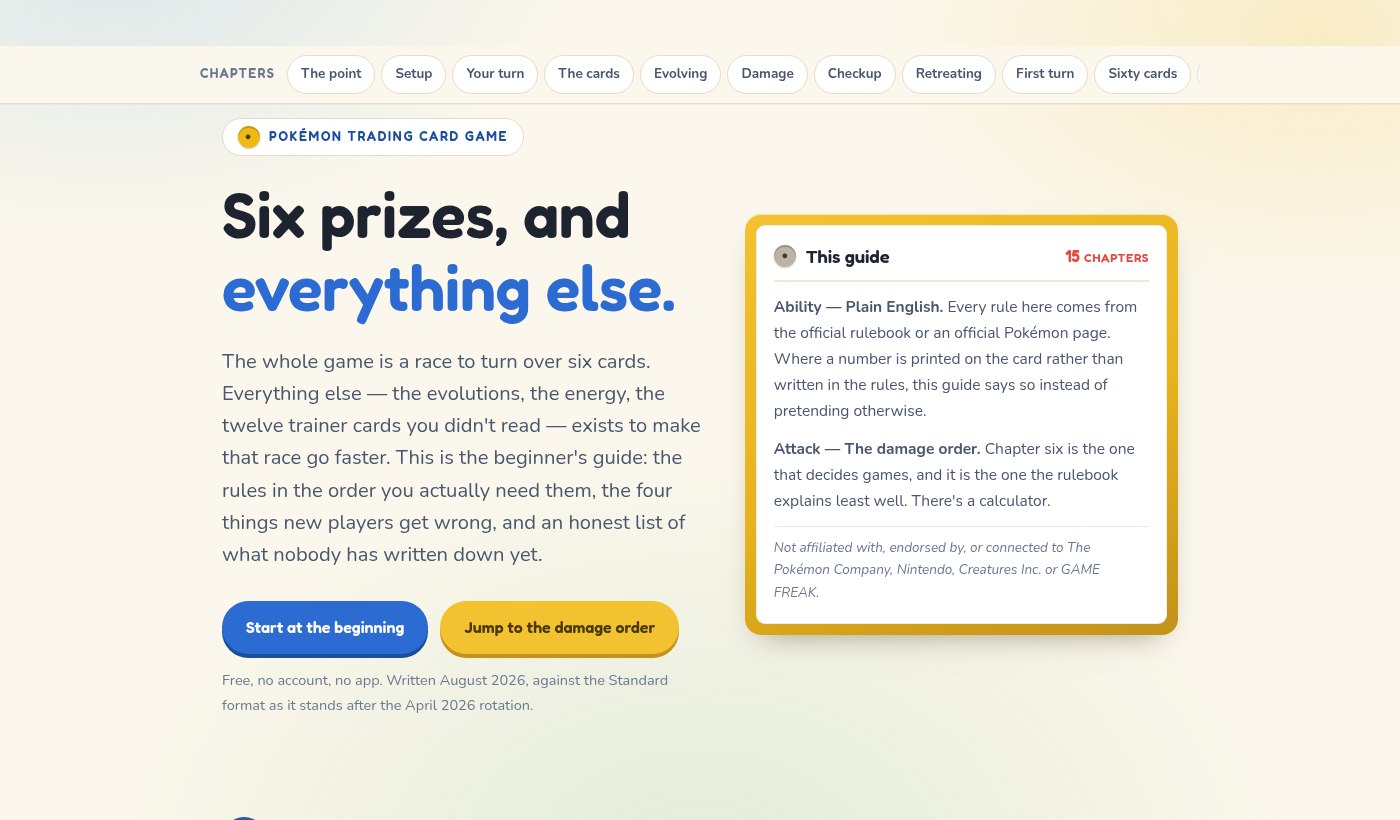
Pokémon Trading Card Game
The biggest card game there is, taught in the order you actually need it. Fifteen chapters: the six-prize race, the turn, evolution's two separate timing rules, the six-step damage order that decides games (with a calculator), the Checkup, deck building, regulation marks, and what to buy first — plus what to unlearn if you arrived from Pokémon TCG Pocket.
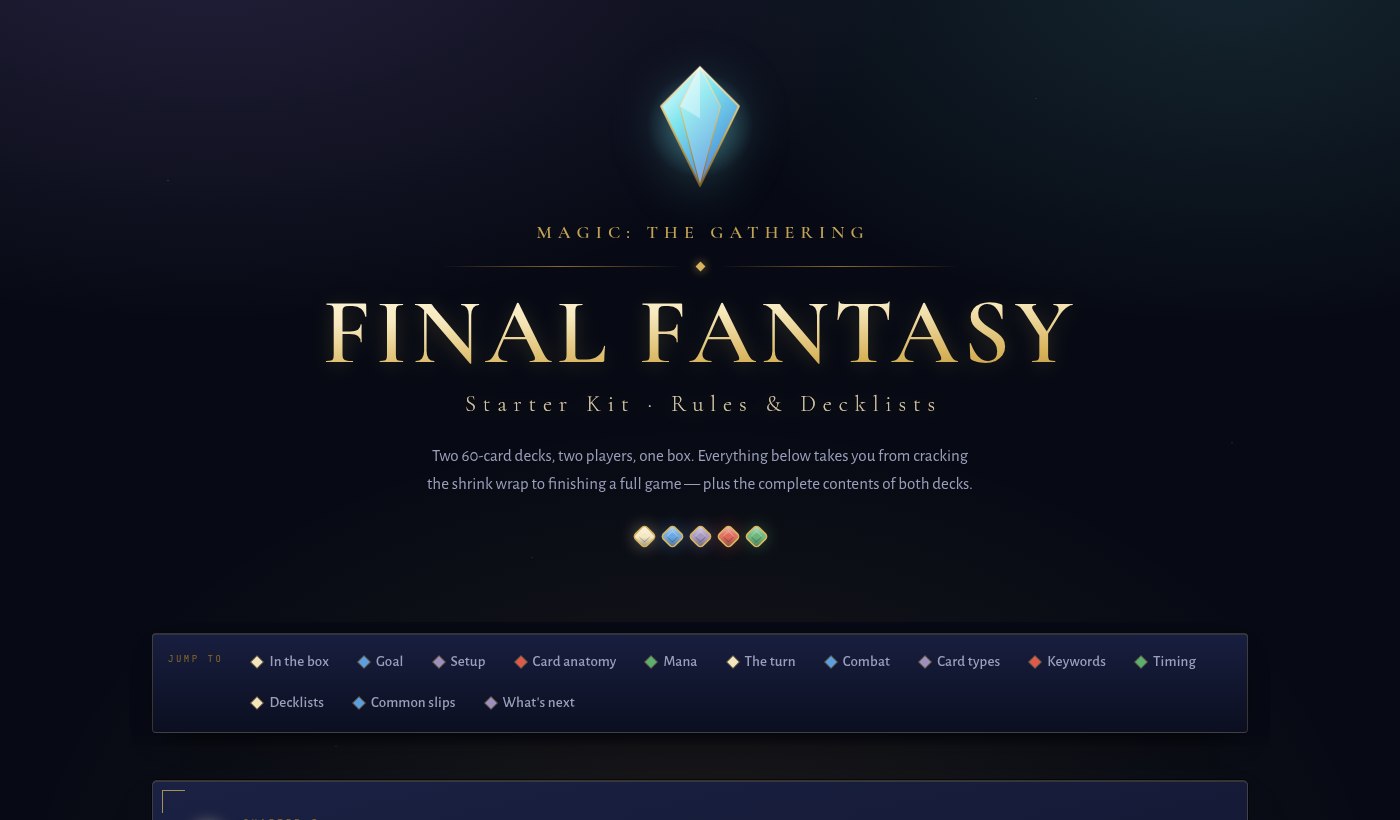
Magic: The Gathering — FINAL FANTASY
The Starter Kit box, taught from the shrink wrap forward. Thirteen chapters covering everything the box assumes you already know: lands and mana, the full turn as a clickable sequence, combat step by step, the stack, the set's own Job select and Tiered mechanics, and both complete 60-card decklists for Cloud and Sephiroth.
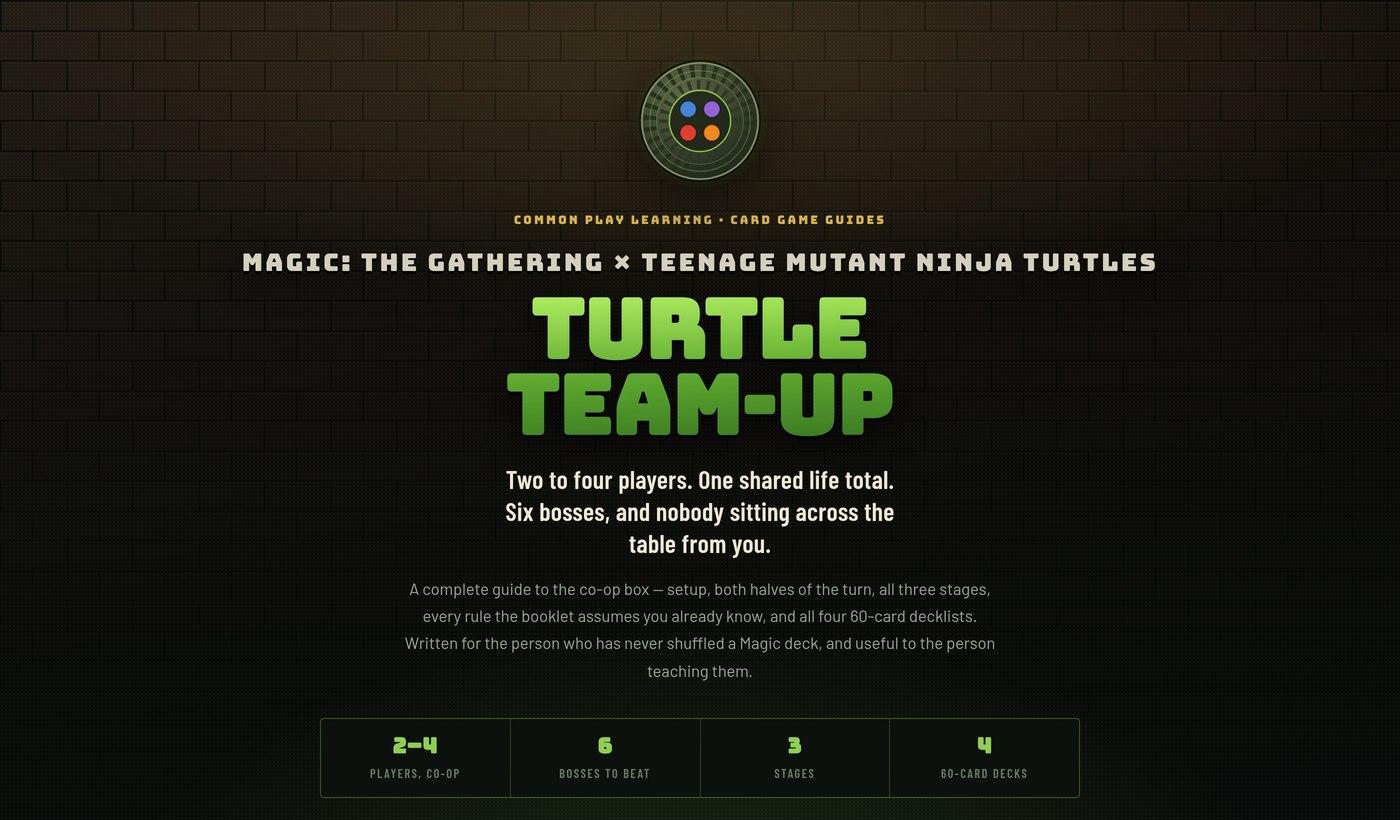
Magic: The Gathering — Turtle Team-Up
The co-op box, where two to four players share one life total and the opponent is a stack of cards that plays itself. Thirteen chapters: setup, both halves of the turn as a stepper, the three boss stages, the damage rule that decides which of your creatures die, all four 60-card decklists — plus printed text for every Boss, Event and Ninja, and six rules the launch-week videos got wrong.
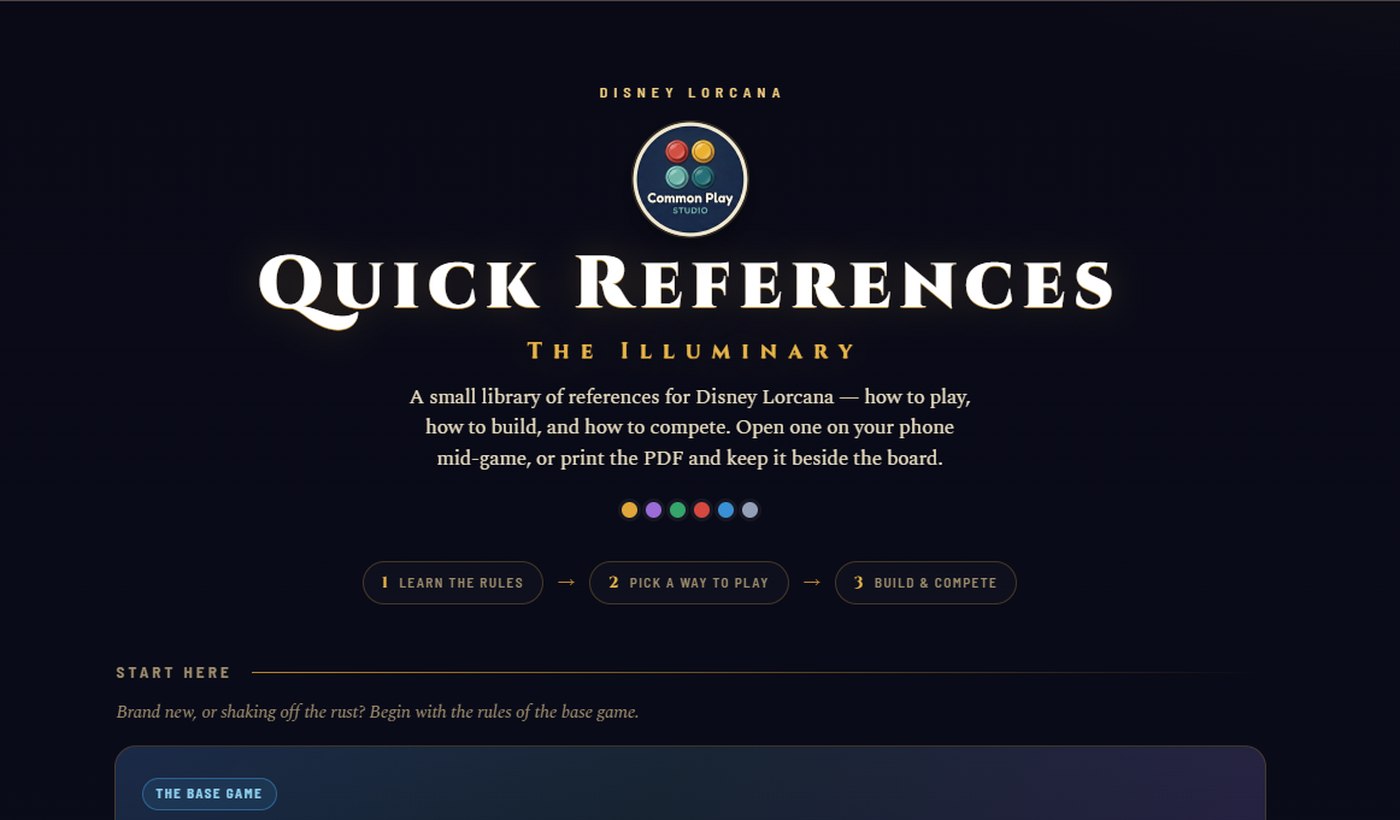
Disney Lorcana — The Illuminary
A reference library rather than a single guide: core rules and the keyword glossary, nine ways to play, both co-op Illumineer's Quest scenarios, the deck-building math behind a consistent sixty, and what the organized-play scene actually expects of you. Built to settle a table argument in ten seconds.
Fighting games
3 guidesEverything happens in real time, and the genre hides its rules behind a wall of jargon. These start with the two or three habits that actually decide low-level matches, then build outward.

Street Fighter 6
Fourteen chapters from install to your first ranked set. Modern vs. Classic controls, an interactive Drive Gauge you can burn out on purpose, anti-airs, frame data in plain English, starter characters, and a practice mindset that keeps you from quitting in week two.
Tekken
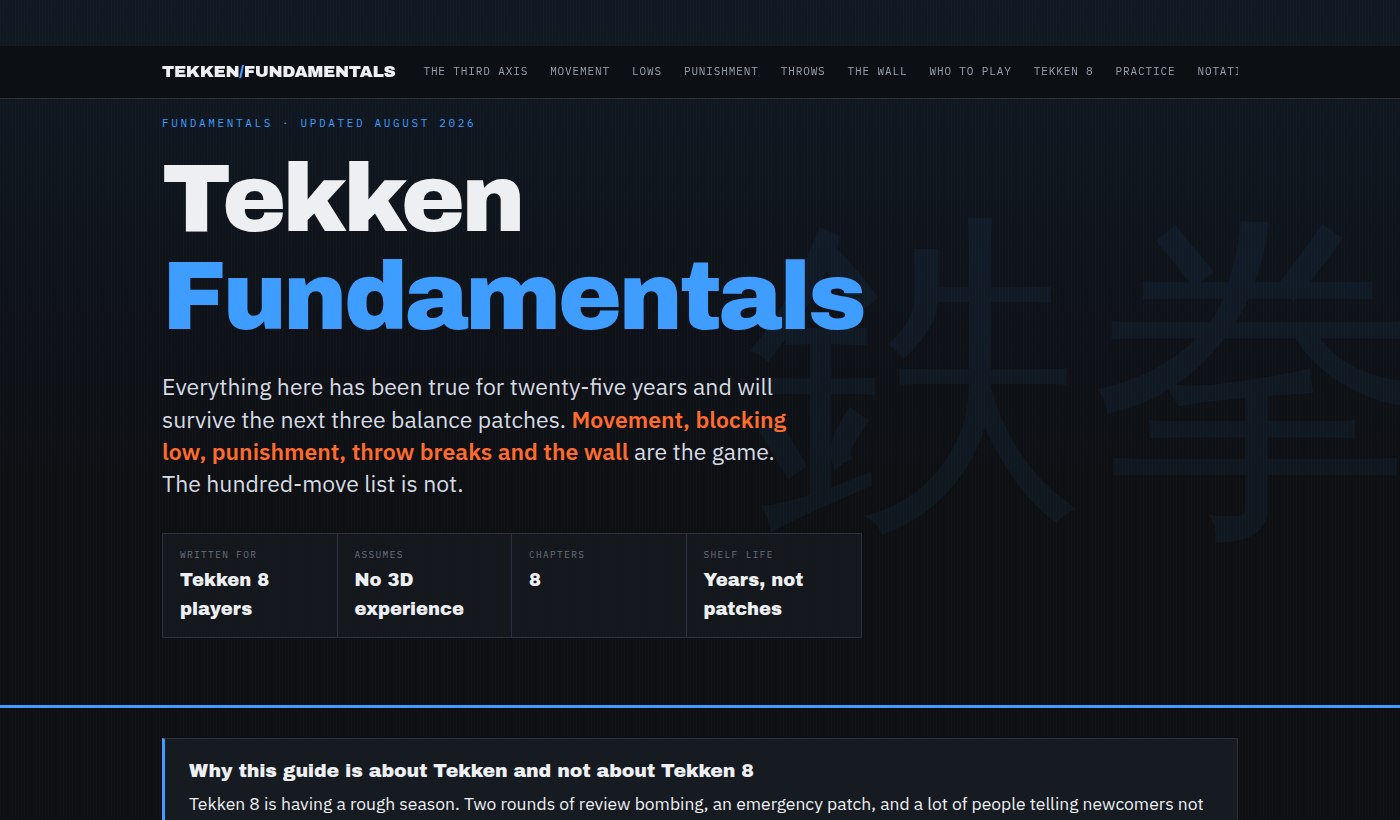
Built deliberately around the parts that don't change. Sidestepping linear attacks, holding down-back, punishing what you block, breaking throws by reading which arm reaches for you, and using the wall — all true since Tekken 3 and all still true after the next patch. One clearly-fenced chapter covers Tekken 8's own Heat and Rage systems.
MARVEL Tōkon: Fighting Souls
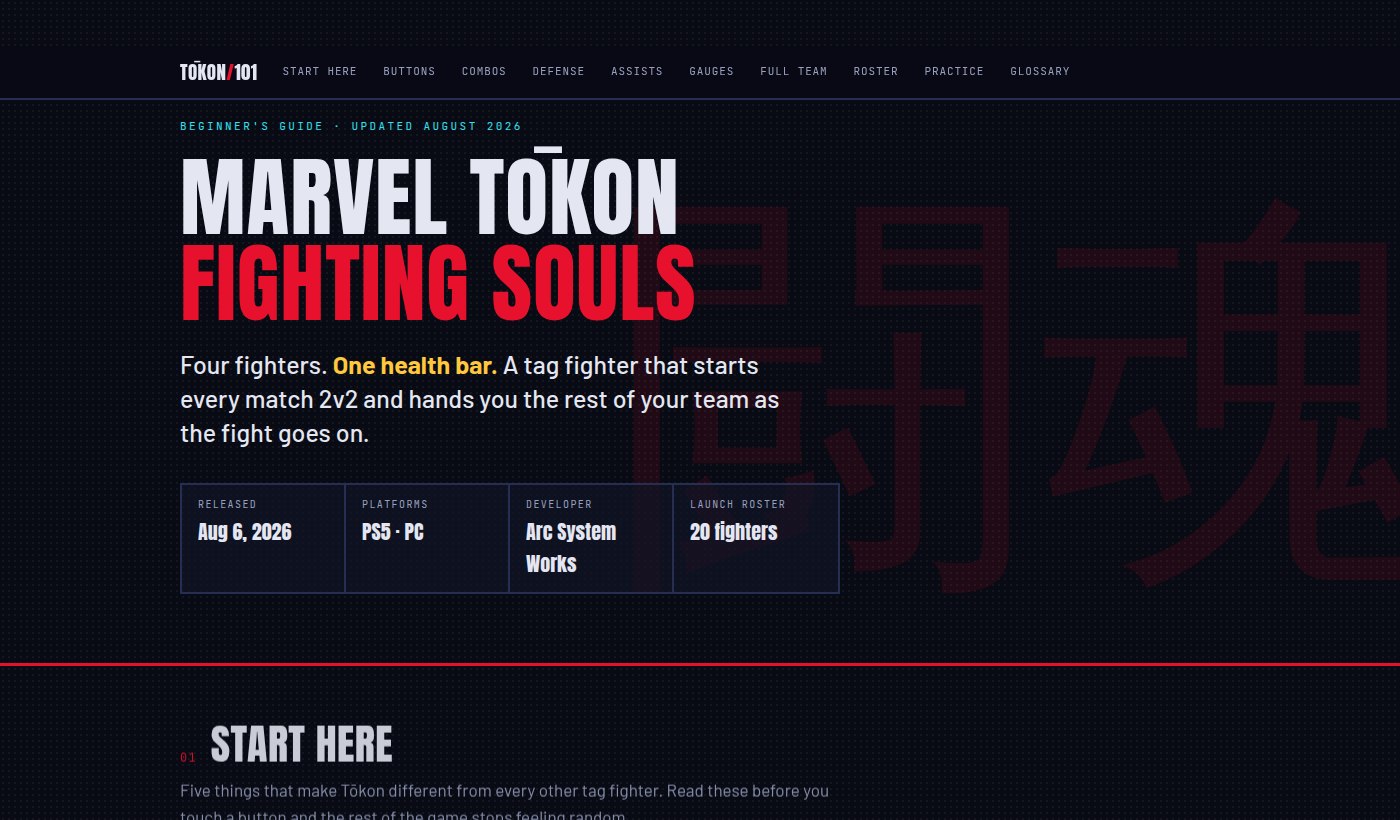
Four fighters, one shared health bar, and a match that starts 2v2 and hands you the rest of your team as it goes. The team layer is the genuinely new part, so the guide spends its time there: assists, switching, the corner Break that unlocks your squad, and a first-week plan that doesn't ask you to learn motion inputs on day one. A second page picks up in week two with combo extension, assist discipline and team order.
Games I'd add next, in rough order of how much I'd learn writing them:
The words nobody stops to define.
Every competitive game has a layer of shared language that experienced players forget they ever learned. Until you have it, you're not losing to better play — you're losing to not knowing what's happening. Learn these once and they follow you between games.
Thirty-seven terms in plain English, with why each one matters. The first group works in any competitive game, cards included.
Everything else worth reading, in one place.
My guides can't cover every game, and shouldn't. So this is the shelf: fifty free things other people made, split the same two ways the guides are. Fighting games get the primers, frame-data explainers, character guides, gear advice and tournament data. Card games get the official rules documents, the card databases everyone actually uses, deck builders, and the tools for finding a table.
Every entry says who made it and when to read it. Links go straight out — nothing here is mine, and none of it is behind a signup.
- Fundamentals & trainingPrimers, frame-data explainers, and a practice plan for training mode
- Per-game guidesStreet Fighter 6, Tekken 8, Guilty Gear, DBFZ, Granblue, Under Night, Killer Instinct, 2XKO
- Card game rules & toolsOfficial rulebooks, Lorcana's card gallery and Dreamborn, Scryfall and the hyperlinked Magic rules
- GearHow to choose a stick or a leverless without spending $200 to find out
- The sceneTournament results, player counts, and how to find a local event near you
Start where you are.
If you already own one of these games, read that guide. If you don't own any of them, read the vocabulary section above — it'll make the next fighting game you try substantially less confusing, whichever one it turns out to be.